
Why Rail Profile Design Matters in Railway Systems
Rails are the backbone of any railway system. They guide train wheels, support extreme loads, and transfer forces efficiently to sleepers and the track foundation.
The design of a rail’s cross-section directly affects safety, durability, and operational efficiency. Among all possible shapes, the I-Section Rail has become the global standard—not by coincidence, but through decades of engineering optimization and real-world validation.
So, what makes the I-section design so effective in railway applications?
Key Components of an I-Section Rail
An I-Section Rail consists of three main parts, each designed for a specific mechanical function:
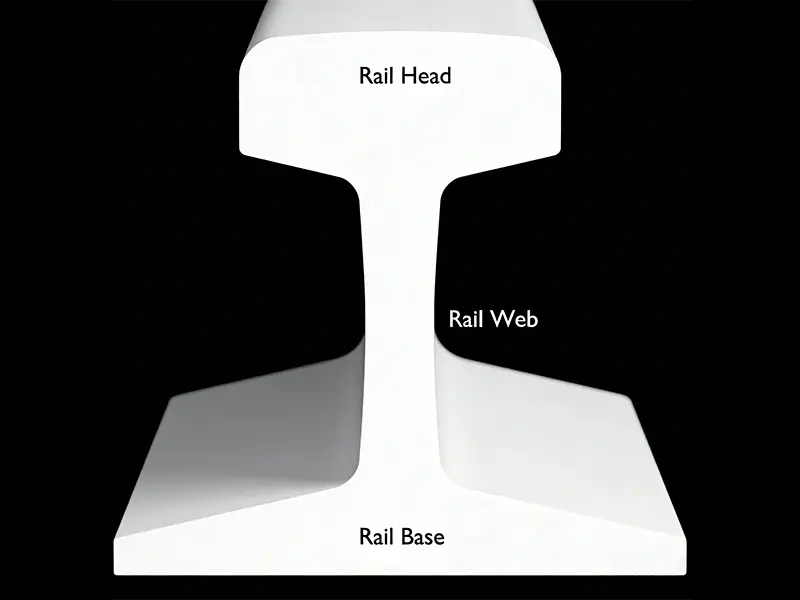
- Rail Head
The rail head is the top portion that comes into direct contact with train wheels. It must provide:
High wear resistance
Smooth contact surface
Accurate profile matching with wheel flanges
A properly designed rail head ensures stable guidance and reduces long-term wear.
- Rail Web
The web connects the head and the base and plays a critical role in:
Load transfer
Resistance to bending stress
Maintaining structural integrity under dynamic loads
Its height and thickness are carefully engineered to balance strength and material efficiency.
- Rail Base
The base is significantly wider than the head. This design:
Increases contact area with sleepers
Improves overall track stability
Works with fastening systems to secure the rail
A wider base ensures that loads are distributed more evenly across the track structure.
Structural Mechanics Behind the I-Section Rail
During operation, rails are subjected primarily to vertical loads. For example, a fully loaded freight train can exert thousands of tons of force on the track.
To resist bending deformation, the rail must have a cross-section that maximizes strength while minimizing material usage. This is where the I-Section Rail excels.
From a material mechanics perspective, the I-shape:
- Concentrates material where stress is highest (head and base)
- Reduces unnecessary material in low-stress areas (web)
- Maximizes bending resistance
In typical rail design:
- Head ≈ 42% of total mass
- Base ≈ 37%
- Web ≈ 21%
This optimized distribution allows the rail to fully utilize the mechanical properties of steel while maintaining cost efficiency.
I-Section vs Other Rail Profiles
Compared to alternative theoretical shapes, the I-Section Rail offers clear advantages:
Superior load-bearing capacity
Efficient material usage
Better resistance to bending and deformation
Proven long-term durability
Other shapes, such as L-section or T-section profiles, are occasionally discussed in theory but are not suitable for modern railway systems:
- L-section: Poor balance and weak structural stability
- T-section: Limited load distribution and lower bending resistance
These limitations highlight why the I-section remains the most reliable solution.
A Proven Design with Over 100 Years of Use
The I-Section Rail was first introduced by Robert L. Stevens in 1830 and has been used ever since.
While modern rail technology has evolved—with improvements in:
- Steel grades
- Heat treatment processes
- Manufacturing precision
The fundamental I-section structure has remained unchanged.
This longevity proves its effectiveness as the most practical and scientifically optimized rail design.
Conclusion: Why the I-Section Rail Remains the Standard
The I-Section Rail continues to dominate railway systems worldwide because it offers the perfect balance between:
- Strength
- Stability
- Material efficiency
- Cost-effectiveness
Even with advancements in high-speed rail and smart infrastructure, this classic design remains essential to safe and reliable rail operations.
About Glory Mining Engineering
At Glory Mining Engineering, we provide high-quality I-Section Rail solutions tailored for mining and industrial applications.
With strict quality control and compliance with international standards such as GB, EN, and AREMA, our products are designed for durability and performance in demanding environments.
Contact our team to discuss your rail project and find the right solution for your application.