
Auxiliary Fans for Mines
Overview
Auxiliary fans for mines are key auxiliary components of mine ventilation systems. They are dedicated to specific branch airways within the mine ventilation network, supplying supplemental airflow and regulating local pressure to assist the main ventilation fan in meeting local ventilation requirements. Auxiliary fans do not drive the overall ventilation system but must be integrated into the permanent ventilation network. They are widely applicable to coal and non-coal mines, tunnels, and other underground works — especially in complex conditions such as high-gas and high-dust environments — and are critical equipment for ensuring safe underground operations.

Core Application Scenarios
Branch airways of underground coal mine ventilation networks (e.g., side branches adjacent to advancing faces, auxiliary airways for extraction zones).
Local ventilation for underground chambers (equipment rooms, maintenance chambers, refuge chambers).
Branch airway ventilation in non-coal mines (metal and non-metal mines).
Local auxiliary ventilation for tunnel engineering (traffic tunnels, mine tunnels).

Common Performance Advantages
Wide environmental adaptability: Designed for stable operation in harsh underground conditions (typical ambient range: −20 °C to +40 °C, relative humidity ≤ 95%).
Stable operation: Smooth performance curve without surge/instability; airflow varies minimally with changes in static pressure.
Safety by design: Supplied with explosion-proof motors and conforming to mine explosion protection standards (e.g., Ex d I Mb), making them suitable for high-gas environments.
Low maintenance: Simple, robust construction; key spare parts (impellers, motors) are easy to replace, reducing downtime and lifecycle maintenance costs.
Energy and environmental performance: High-efficiency models can reduce the number of units required, extend effective delivery distance and reduce overall ventilation energy consumption.
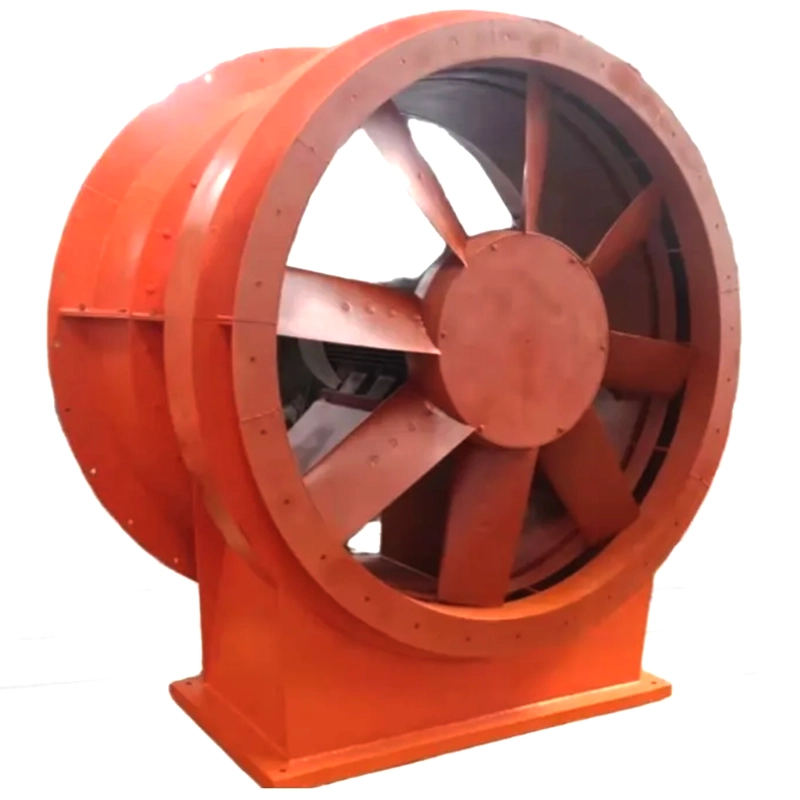
Key Product Advantages
High delivery capability: Capable of stably supplying required airflow for branch roadways up to typical lengths (e.g., ≤ 200 m) without frequent relocations.
Flexible operation modes: Counter-rotating and other designs support whole-unit or staged operation, enabling dynamic adjustment to system resistance and saving energy.
Robust safety and anti-reverse wind performance: Reliable operation under low-flow or backflow conditions, effectively coping with gas and dust hazards.
Low total cost of ownership: Modular design and common spare parts facilitate rapid repair and reduce maintenance overhead.
Different types of auxiliary fans have distinct characteristics and application scopes. Select the appropriate type according to ventilation requirements.


Purchasing & Selection Recommendations
Define site requirements: Confirm airway length, system resistance (static pressure or resistance curve), required airflow, and target entry/exit pressures.
Match the fan type to the application:
For airway lengths ≤ 2000 m where long steady delivery is required, prioritize counter-rotating or high-efficiency axial types.
For high resistance or directional ducted delivery, select a centrifugal design or a higher-power model (e.g., FBDNo6.0/2×18.5).
Prioritize efficiency: Choose models with full-pressure efficiency ≥ 80% to minimize long-term electrical costs.
Verify safety certifications: Ensure the product bears the China Mine Safety Mark (MA) and holds appropriate explosion-proof certification (for example Ex d I Mb).
Consider spare parts & service: Prefer manufacturers with large installed base, dependable brand reputation, and broad after-sales/support networks for stable spare-parts supply.
Installation & Operational Notes
Permanent network integration: Install the auxiliary fan per the mine’s permanent ventilation design and ensure coordinated control with the main fan.
Explosion protection & earthing: Use explosion-proof motors, certified explosion-proof cabling, and reliable equipment grounding.
Vibration & noise control: Provide vibration-isolating foundations and acoustic mitigation measures where operational noise affects working faces.
Routine maintenance: High-frequency inspection items include bearings, seals, motor windings, impeller integrity, dust removal systems and lubrication scheduling.
FAQs
Q:Are these fans suitable for high-gas roadways?
A: Yes — provided the chosen model is equipped with certified explosion-proof motors and is integrated with appropriate gas control and monitoring measures.
Q:Can multiple units be run in parallel?
A: Yes. Parallel or staged operation is feasible but requires matched fan characteristics and a control scheme for airflow/pressure balancing.
Q: Is on-site maintenance difficult?
A: No — designs emphasize maintainability; common spare parts are standardized and the impeller/motor modules are serviceable with routine tools.