
Steel Grinding Balls
Overview
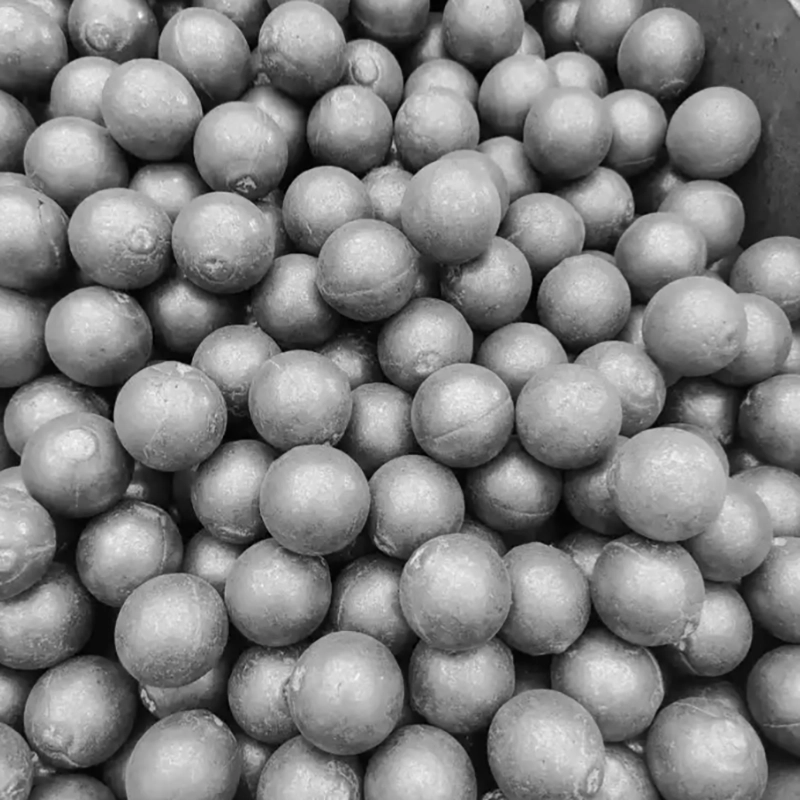
Steel grinding balls are the primary grinding media used in ball and rod mills. Grinding is achieved through ball-to-ball and ball-to-ore impact and abrasion. Our range supports wet/dry, coarse/fine grinding and fits gold, copper, iron, silica and other mineral processing flows. Proper selection affects grinding efficiency, particle size distribution and overall processing cost.
Core Value
Full-spectrum materials: Solutions from ultra-wear-resistant high-chrome to high-impact high-manganese, corrosion-resistant and economical options.
Strict process control & traceability: Induction melting, forging/casting, austempering & tempering, with metallography and wear testing per batch.
Smart & green ready: Diameter tolerance ≤ ±1mm for automated mills; lead-free alloys for wet metallurgy complying with RoHS.
Balance wear resistance with economy — help your mill cut cost and raise throughput.


Key Advantages
1) Material options — matched to operating conditions
High-chrome (wear-resistant): Cr ≥ 10%, HRC 58–65 — reduces wear by >60% vs. standard cast balls in many conditions.
High-carbon, high-manganese (impact-resistant): Made from quality 65Mn, B2 base alloys — excellent toughness, low breakage rates.
Economical low-carbon alloy: Lifetime ~2× traditional low-chrome cast balls; lowers initial procurement cost by ~30%.
Corrosion-resistant alloy: Special alloying with rare earth elements for acid/slurry resistance in wet metallurgy and tailings regrind.
2) Process control & quality assurance
Raw materials: low-sulfur, low-phosphorus scrap steel (S, P < 0.05%).
Production flow: induction melting → forging/casting → austempering (isothermal quenching) → tempering. TiB2 reinforcement available for cast products to increase wear resistance.
Inspection: metallographic analysis, hardness mapping and wear testing provided per batch; third-party testing (e.g., SGS) supported.
3) Smart manufacturing & environmental compliance
Diameter tolerance ≤ ±1mm and consistent surface finish for automatic mill recognition and handling.
Lead-free wet-metallurgy alloys meet RoHS limits and help reduce slurry contamination.
Practical Selection Guide
— Four Steps
Characterize the ore
Hardness: for Mohs > 6 choose high-chrome; Mohs 3–6 choose low-carbon alloy.
Chemical environment: if slurry pH < 6 (acidic), use corrosion-resistant alloy.
Match process parameters
Wet milling: prefer high-chrome to reduce iron contamination from media.
Dry milling: use high-carbon high-mn for impact resistance.
Ball diameter: use Bond formula (D = 28 × √F80) as a starting point — e.g., F80 = 80 mm → ~100 mm ball.
Balance economy vs. lifetime
Large, continuous operations (>5,000 t/day): high-chrome often yields lower total annual cost despite higher upfront price.
Short-term projects (<1 year): low-carbon alloy reduces initial capital.
High-impact environments (e.g., semi-autogenous feed): favor high-carbon high-mn.
Verify standards & supplier documentation
Prefer products compliant with YBT 091-2005 and ISO 9000.
Require spectral analysis, heat-treatment records and 30-day field wear test data.


Typical Application Case Studies
Magnetite, wet fine grinding: High-chrome cast Φ40–Φ80 mm — +25% grinding efficiency; media consumption reduced to 0.8 kg/t.
Hematite, dry coarse grinding: High-carbon high-mn forged Φ100–Φ120 mm — breakage rate <0.5%; monthly make-up reduced by ~30 t.
Gold, flotation feed: Lead-free high-chrome Φ30–Φ50 mm — slurry Fe contamination <0.1%; gold recovery improved ~3%.
Acid tailings regrind: Corrosion-resistant Φ50–Φ70 mm — service life ~12 months, +8 months vs. standard balls.
Quality Assurance & Services
Batch reports: metallography, hardness maps and wear test certificates; third-party testing available (e.g., SGS).
Customization: special alloys (e.g., B3, 75mncr) and diameters Φ20–Φ150 mm; typical lead time for custom batches: 15 days.
After-sales: on-site charge design, wear monitoring and top-up strategy optimization.
FAQs
Q:Can I get samples and field trials?
A: Yes — small-sample trials and 30-day field wear tests are available under trial agreements.
Q: Do you accept third-party testing?
A:Yes — SGS, CIQ and other third-party reports can be supplied per batch.