
Heavy Mining Railways
Heavy Mining Railways Series is engineered for surface mining haulage, heavy mine cars, and locomotive-train lines subject to elevated static and dynamic loads. Our rail portfolio is available in standard nominal weights of 38, 43, 50, 60 and 75 kg/m, with bespoke profiles and intermediate weights available on request. Components are manufactured and supplied to meet customer specifications and applicable international standards.

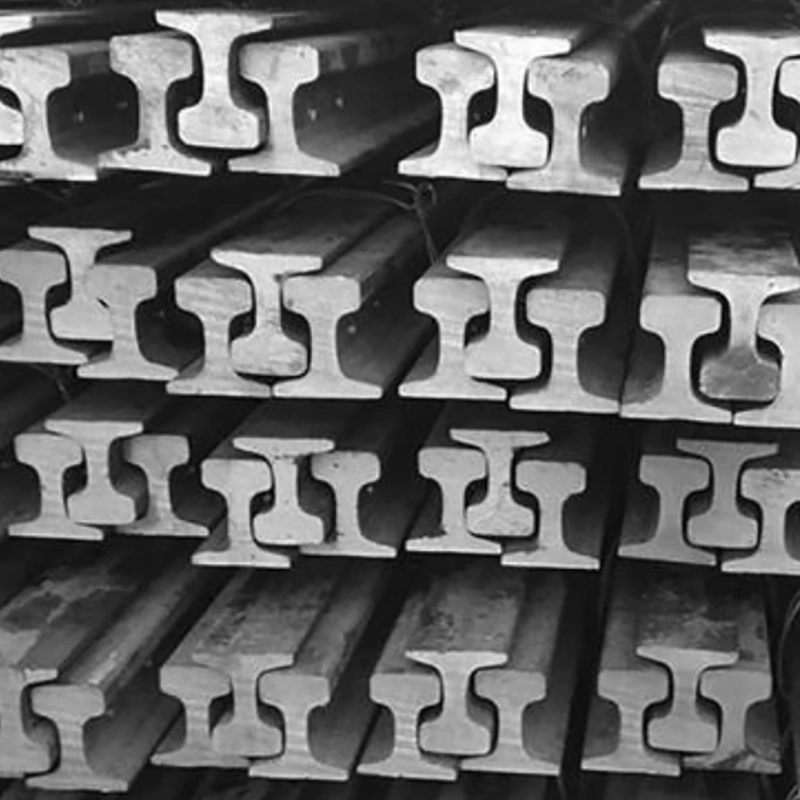
Typical applications
- Surface-mining haulage lines (short and long haul)
- Locomotive-drawn ore trains and heavy mine cars
- Heavy internal mine loops, loading/unloading yards and transfer corridors
- Mainline heavy-haul corridors inside mines requiring long-rail fabrications
- Special projects requiring high section modulus (e.g., transfer stations, heavy-load spurs)
Key advantages
- High load capacity — sections (38–75 kg/m) designed for heavy static and dynamic axle loads.
- Proven steel grade (U71Mn) — good balance of tensile strength, toughness and wear resistance for heavy-haul conditions.
- Fatigue resistance — profiles and manufacturing practices reduce crack initiation under cyclic loading.
- Customisability — cut-to-length, welded long-rail fabrication, bespoke profiles and alternative grades available.
- Supply & QA traceability — mill test certificates (MTCs), dimensional inspection and NDT available per order.
- Serviceability — designs compatible with standard thermite and flash-butt welding processes for on-site joining and repairs.
Installation & maintenance recommendations
Pre-installation
Verify rail profile, grade (U71Mn by default), length and mill certificates against the purchase order.
Plan logistics for heavy-lift offloading, skid layout and temporary storage to avoid rail deformation.
Ensure all site lifting equipment is certified and rated for rail weights and lengths.
Handling & storage
Store rails on stable, level skids with adequate support to prevent bending.
Protect rail ends and surfaces from corrosion during storage (covers, desiccants for long storage).
Avoid dropping rails; use spreader bars or soft slings to prevent local damage.
Installation (high-level)
Use qualified, trained crews for alignment, bedding and welding. Follow site lifting/safety procedures.
Bedding: ensure correct ballast/bed preparation and tamping consistent with the rail section and traffic loads.
Jointing: use thermite or flash-butt welding by certified technicians for long-rail; bolted joints should use specified bolt grades and torques and be fitted with properly sized fishplates and insulation where required.
Alignment & geometry: check track gauge, cant, and longitudinal alignment after installation and before commissioning.
FAQs
Q: What is the standard steel grade for the Heavy Rail Series?
A: Standard grade is U71Mn. Alternative grades and heat-treatments are available on request.
Q: Are coatings or surface treatments available?
A:Yes — protective coatings, anti-corrosion treatments and surface finishing options are available as order options.
Q: How should I request a quotation?
A: Provide: profile (kg/m or drawing), quantity (tonnes or number of rails), lengths and tolerances, material grade (U71Mn or alternative), delivery location and any special processing or certification needs.