
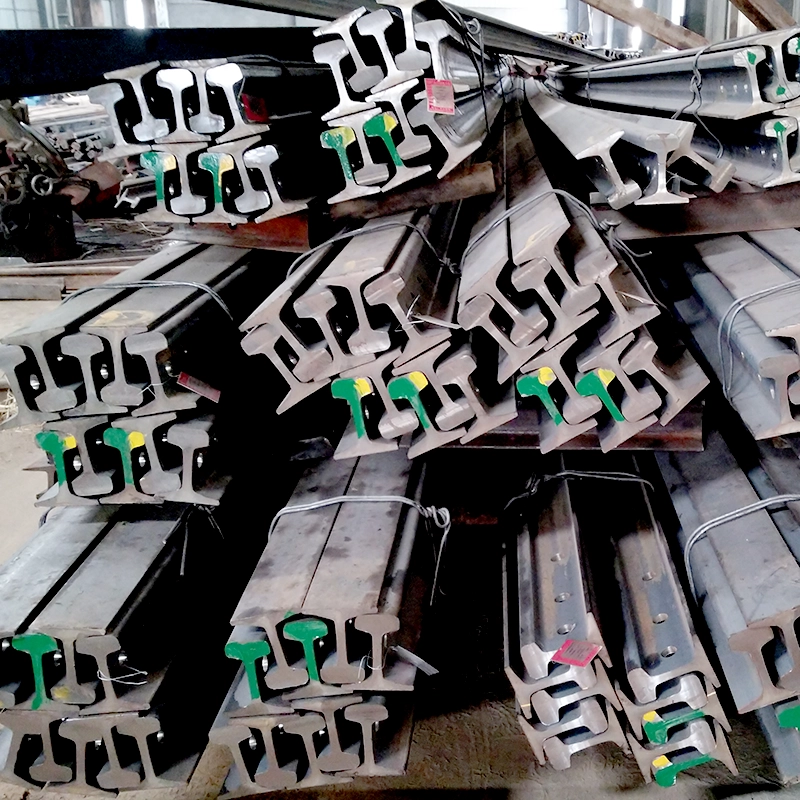
38 kg Rail
Manufactured to GB/T 2585-2021 • Tensile strength ≥ 880 MPa • Service life 15+ years
Cost-efficient: At 38.733 kg/m this rail lowers transport and civil works costs without compromising required load capacity.
Versatile: Ideal for branch lines, temporary construction tracks, tourist railways and a variety of industrial track uses.
Durable: Optimized chemistry and heat treatment improve fatigue resistance and wear life, extending service intervals.

Key Points
Standards & Performance: Produced to GB/T 2585-2021 with a minimum tensile strength of 880 MPa and an expected service life of 15–30 years.
Material Options: Available in 55Q (budget option) and U71Mn (performance-balanced option) to suit light and medium load applications.
Lightweight Design: 38.733 kg/m reduces shipping and installation costs while supporting axle loads up to 25 tonnes.
Proven Manufacturing: Universal rolling mill plus on-line quenching delivers a head hardness of 280–320 HB and tight dimensional control.
Comprehensive Testing: 12 inspection items including ultrasonic and magnetic particle testing; 100% internal defect coverage. ISO 9001 and optional CE certification available.
Fast Response: Stocked items and custom production available — Delivery time subject to availability, with fastest shipment within 3 days.
Technical Specifications
| Parameter | Value | Notes |
|---|---|---|
| Model / Marking | 38 kg/m | Industry standard nominal weight |
| Cross-section dimensions | Height 134 mm (5.28 in); Base 114 mm (4.49 in); Head 68 mm (2.68 in); Web thickness 13 mm (0.51 in) | Matches medium-duty rail accessory sizes (e.g., fishplates, fasteners) |
| Material | 55Q carbon steel / U71Mn medium-carbon manganese steel | 55Q: Cost-effective, good ductility; U71Mn: Balanced strength & wear resistance |
| Theoretical weight | 38.733 kg/m (~25.98 lb/ft) | Actual ±0.5% permitted (per GB/T 2585-2021 standard) |
| Standard lengths | 12.5 m / 25 m (custom services available) | Custom lengths available — please confirm at enquiry |
| Execution standard | GB/T 2585-2021 (Hot-rolled Rails for Railway Use) | National standard for medium/heavy-duty rail products |
| Mechanical properties | 55Q: Yield ≥ 300 MPa; Tensile ≥ 600 MPa; U71Mn: Yield ≥ 400 MPa; Tensile ≥ 880 MPa | 55Q: Axle load ≤20 tons; U71Mn: Axle load ≤25 tons |
| Surface treatment | Natural rust / passivation options | Improves corrosion resistance in industrial/mining/damp environments |
Manufacturing & Quality Control
Steelmaking: Converter steelmaking with ladle refining; strict control of chemical composition, S & P ≤ 0.025%.
Rolling: Universal rolling mill ensures dimensional accuracy; head tread flatness within 0.1 mm/m.
Heat treatment: On-line quenching for improved head hardness and wear resistance.
Testing: Ultrasonic and magnetic particle testing, hardness and tensile tests — 100% inspection for internal defects across production.

Applications
Railway
Branch lines: local freight, mine branches — reduced initial investment and operating cost.
Temporary construction tracks: reusable for multiple projects.
Tourist and scenic railways: engineered for lower noise and vibration for small tram or tourist vehicles.
Industrial
Crane rails: suitable for 5–20 tonne overhead cranes when paired with elastic clips and compatible fastenings.
Port yards: container stacking tracks where wear resistance reduces maintenance frequency.
In-plant steel and material handling: performs well under frequent start/stop cycles and tight curves, with up to ~20% longer life versus standard rails.
Supervision Loading Photos
Process & Efficiency-Focused Version
Indonesia-dedicated packaging for 38kg rails and accessories features full-process standardized control—from batch-by-batch inspection, classified protection, to precise container selection and integral reinforcement. Complete customs clearance documents are provided to ensure efficient and compliant direct delivery to the destination port, giving clients total peace of mind.
Installation
Base preparation: Fix to concrete or wooden sleepers; maintain gauge tolerance within ±2 mm.
Jointing: Fishplates with high-strength bolts; joint gap ≤2 mm to ensure electrical continuity and strength.
Commissioning checks: Track inspection trolley to verify geometry; vertical profile tolerance ≤5 mm per 10 m.
How to Order
Submit requirements: Use the online inquiry form (Contact Us) or the quote form below. Provide quantity, preferred grade (55Q/U71Mn), single rail length and delivery location.
Proposal & approval: Our technical team will supply a customized solution including drawings and cost estimate.
Contract: Contract will define quality standards, delivery schedule and payment terms (T/T, L/C available).
Production & shipping: Stock rails shipped from inventory; custom orders produced per contract. Domestic delivery by dedicated logistics; international shipment via sea or air.
Maintenance Recommendations
Routine inspection: Check head wear quarterly; replace if side wear >12 mm.
Lubrication: Apply rail lubricant on curves to reduce wheel-rail friction and noise (up to ~30% noise reduction reported).
Repairs: Minor wear can be corrected by milling/grinding; severe damage requires welding or replacement — U71Mn is more weld-friendly.
After‑sales & Warranty
Warranty: 12 months from acceptance. Material defects covered by free replacement within warranty period.
Technical support: 24-hour contact for installation guidance and troubleshooting (remote or on-site as required).
Follow-up: Biannual site visits with an engineer and a written “Track Health Report”.
FAQs
Q:How to choose between 55Q and U71Mn?
A:55Q suits budget-sensitive, light‑load scenarios. U71Mn offers better wear and fatigue resistance and is recommended where loads or operating conditions are more demanding.
Q:How should rust on rails be treated?
A:Light surface rust can be removed by grinding and then coated with an anti-corrosion (rust-preventative) paint. Severe corrosion requires replacement to avoid safety risks.
Q: Can 38 kg rail be used on high-speed lines?
A: Not recommended. High-speed lines typically require rails of 60 kg/m or heavier; 38 kg rails are intended for conventional branch lines.